

The pharmaceutical industry showed impressive performance in Q2 2024, with a notable focus on innovation and expansion.
Most companies exceeded earnings expectations and are optimistic about the remainder of the year. Key drivers of this growth include oncology, immunology, and specialty care, supported by strategic cost management and new product launches. Despite some challenges in vaccine sales and supply constraints, the overall sentiment remains positive.
What you’ll gain from this report:
- Future Outlook – Gain a deeper understanding of what these companies are saying about their quarterly performance and their outlook for the remainder of the year.
- Leadership Analysis – Discover how industry leaders interpret and communicate their results, impacting their perceived value and strategic direction.
- Regulatory and Clinical Developments – Explore the significant achievements in regulatory approvals and clinical developments that defined Q2.
- Analyst Reports – See how top analyst firms are dissecting these results, providing nuanced analyses of growth catalysts and challenges ahead.
Q2/H1 Reports Summary
- With very few exceptions, analysts valued Q2 results as solid and promising for most pharma companies.
- They also noted the continued focus on R&D investments, strategic M&A activities, and pipelineadvancements.
- Half of the companies in this analysis are raising their guidance for the year, after very positive Q2 results.
- However, there are still concerns about pricing pressures, regulatory challenges, and the potential impact ofpatent expirations on future earnings.
- Covid-19 continue losing weight in portfolios, although the impact during the next winter season is still inquestion.
- Biosimilars are increasing penetration in some areas, which represents a major threat for some companies,but new products are more than compensating the patent cliff in many cases.
- Some companies are relying too much in one or two products and need portfolio diversification lookingforward.
- Therefore, M&A deals continue to be an area to look at, with some companies quite active in this field. It is likely that new deals will be performed during the rest of the year.
- Overall, the outlook for the pharma industry remains positive, with expectations for sustained growth and innovation.
Summary of Key Figures

H1 Pharma Sales ranking in USD

Pfizer

Company’s view
Dr. Albert Bourla, Chairman and Chief Executive Officer, stated:
“Pfizer has made significant progress toward our goal to launch 19 new products and indications in an 18-month span, having executed eleven launches thus far. We continue to build momentum in 2023, recently attaining key milestones for several products, including the U.S. launches of Prevnar 20 in pediatric patients and Zavzpret; U.S. approvals and launches for Abrysvo in older adults, Litfulo and the Talzenna plusXtandi combination; U.S. approvals for Ngenla (expected tobe available for prescribing this month) and Paxlovid; and U.S.regulatory filing acceptance for fidanacogene elaparvovec(Hemophilia B Gene Therapy). Finally, we continue to make progress toward our proposedacquisition of Seagen.”
Outlook: Confirmed
Narrows 2023 Revenue Guidance Range to $67 to $70 Billionand Adjusts 2023 Non-COVID Operational Revenue GrowthExpectation to 6% to 8%.
Maintains All Other Components of Full-Year 2023 FinancialGuidance, Including Guidance for Adjusted Diluted EPS.
Product sales / Clinical / Regulatory

Clinical Development / Regulatory
- Data reported from several pipeline candidates believed to have the potential to be significant future value-drivers:
- Phase 3 data from marstacimab, Pfizer’s novel, investigational anti-TFPI antibody being studied for the treatment of hemophilia A or B.
- Further data from elranatamab, Pfizer’s investigationalBCMA CD3-targeted bispecific antibody currently being investigated in multiple myeloma.
- First-in-human data from potential next-generation breast cancer treatments, including our novel CDK4, CDK2, andKAT6 inhibitors.
Analyst’s view
Evercore:
Quarter is not so hot on top line: COVID is a big driver of the miss ... and while COVID miss is not unexpected, Prevnar20franchise also tracked lower. In addition, a couple of launches tracking lower for FY guidance.However, the single biggest thing that stands out to me inPFE’s new disclosures is that given COVID uncertainty, PFE intends to launch an “enterprise-wide cost improvement program” ... and has identified specific areas to make cost base adjustments – primarily in COVID cost base (assuming demand remains lower than expectation – as it has in 1H). IfPFE can find a way to deliver 50c - $1 in EPS from cost cut, that will be a big deal (although I acknowledge that $1 in EPS means >$7B cost cut – which is likely not what they are referring to right now).
Equity Research:
Q3 could be a decisive qtr for PFE as early COVID commercial dynamics set the stage for later years, and contributions from new launches settle in. Depending onCOVID biz success, PFE could enact cost cuts in bid to expand margins. New PT $39 by DCF.
J&J

Company’s view
“Our robust performance in the second quarter and first half of 2023 is a testament to the hard work and commitment of our colleagues around the world,” said Joaquin Duato, Chairman of the Board and Chief Executive Officer. “We are entering the back half of the year from a position of strength with numerous catalysts, including becoming a two-sector company focused on Pharmaceutical and MedTech innovation.”
Outlook: Raised
Johnson & Johnson now expects sales this year of between $98.8 billion and $99.8 billion, with both ends lifted by $900 million from the guidance issued in April. The company added that it sees "slightly higher" operational sales growth in the second half of the year for prescription drugs.
Chief financial officer Joseph Wolk noted that Johnson & Johnson had been "responsibly cautious" in its prior 2023 guidance, but growth across the business gave it confidence to raise its outlook. "The qualifiers are now off, and if you look across our entire portfolio -- just strength across the board," Wolk said, with the company's shares rising more than 6% on the news.
Product sales / Clinical / Regulatory

Analyst’s view
Wells Fargo:
JNJ reported Q2 results ahead of expectations driven by broad-based strength despite supply challenges. Raised 2023 guidance seems reasonable. We could see KVUE spin complete as soon as Q3. Voracious M&A appetite could signal a deal coming.
Morgan Stanley:
Solid 2Q results and Kenvue split off dynamics are a positive, but we weigh this against ongoing talc litigation. We adjust our estimates and maintain our price target and EW rating.
Bernstein:
Johnson & Johnson 2Q23: Solid beat and raise; "voracious" M&A appetite; Kenvue exchange offer imminent.
Despite the KVUE spin, management wants to make it clear that JNJ is open for business on M&A. Targets can be big or small, as long as strategic fit and financial upside is there.
Talc saga continues. JNJ is set to appeal the recent $18.8mn jury award to a talc litigation plaintiff in California. LTL has two hearings in bankruptcy court scheduled for August, which should provide JNJ shareholders with additional clarity into whether the reorganization plan will be accepted.
Roche

Company’s view
Roche CEO Thomas Schinecker:
“In the first half of 2023, sales in the base business of both our divisions grew strongly, largely offsetting the impact of declining demand for COVID-19 products. Vabysmo continues its strong momentum – now providing treatment for patients with severe eye conditions in over 70 countries. We reached several important pipeline milestones, including the US and EU approvals of our blood cancer medicine Columvi. I am also excited about our partnership with Alnylam to develop a potentially transformative medicine for patients living with hypertension, which affects 1.2 billion adults worldwide and is the leading cause of death from cardiovascular disease. We confirm our outlook for 2023.”
Outlook: Confirmed
Roche reiterated that due to an anticipated "sharp decline" in sales of COVID-19 products of approximately CHF 5 billion, it expects a decrease in group revenues in the low-single-digit range at constant exchange rates. Excluding the impact of this COVID-19 sales decline, Roche anticipates solid sales growth for the base business of both its pharmaceuticals and diagnostics divisions.
Product sales / Clinical / Regulatory

Clinical Development / Regulatory
- Readout of final overall survival (OS) data from the SKYSCRAPER-01 study evaluating the combination of tiragolumab and Tecentriq in non-small-cell lung cancer (NSCLC) looks to have been delayed until the first quarter of 2024.
- Roche also confirmed it has discontinued development of the investigational stroke treatment RG3625 following Phase III study failure and halted evaluation of the Phase II asset RG6358/SPK-8016 as a potential therapy for haemophilia A in patients with inhibitors to factor VIII.
Analyst’s view
Morgan Stanley:
The reported 2Q23 performance missed consensus on Group sales by 1% (-CHF 140m), driven by a 5% miss in Diagnostics with Pharma sales in line. The standout positives were Vabysmo once again beating expectations by 9% (+CHF42m; nearing the CHF1bn market in 1H23) with strong performance across geographies (US: ~30% naive patients up from ~12% 1Q23 results, ~70% switches (mostly from Eylea); JP/UK/CH/AUS: double-digit market share in early launch countries; US market shares 15% nAMD and 9% in DME), where we expect patients warehoused for the launch of Eylea HD (now delayed) will initiate treatment on Vabysmo. Polivy beat consensus by 19% reflecting stronger than expected broad 1L DLBCL uptake and Phesgo continued its strong launch momentum (+8% vs. cons.; 35% conversion in early launch countries).
In terms of misses, Tecentriq will be the focus after missing by 7%, with Keytruda share gains in adjuvant lung (broader label) having an impact with Tecentriq share plateauing in NSCLC. Elsewhere, Ocrevus was in line and Hemlibra was a 3% miss. In diagnostics, the miss vs. consensus (CHF192m) was likely driven by lower Covid sales than expected (CHF0.3bn Q1 to CHF0.1bn in Q2), in line with our expectations. This likely provides the new Covid revenue base going forward. Positively, the Diagnostics base business returned to HSD growth in 2Q (8% CER). Costs were broadly in line with expectations with differences vs. consensus in divisional operating profit likely driven by Roche's new reporting structure (boosts divisional margins with costs moved to corporate). Core EPS was in line vs. expectations.
Merck

Company’s view
“We continue to make great progress as we advance our road and deep pipeline, raise the bar of innovation, and bring forward leading-edge science to save and improve lives around the world,” said Robert M. Davis, chairman and chief executive officer Merck. “We delivered robust underlying growth during the second quarter and are well positioned to achieve strong full-year results.
Davis noted that the Prometheus purchase will not constrain the company's ability to do more deals, and it continues to "look for science-driven, science-led opportunities." The executive remarked "while I feel pretty good about what we have in the internal pipeline and the progress we're making, we know there's more to do."
According to Davis, the performance of Keytruda is "really driven by very strong uptake as we're continuing to move into earlier lines of cancer," with use in triple-negative breast cancer also contributing to the product's growth. Meanwhile, the use of Gardasil in China was the biggest driver of growth for the HPV vaccine, which could see increased sales as it is utilised in males.
Outlook: Raised
Merck & Co. now expects to generate sales this year of between $58.6 billion and $59.6 billion, boosted from an earlier estimated range of $57.7 billion to $58.9 million. The company noted that the forecast continues to include approximately $1 billion in revenue from Lagevrio.
Product sales / Clinical / Regulatory

Clinical Development / Regulatory
- Positive Phase 3 topline data from adult pneumococcal vaccine candidate V116.
- Imminent initiation of multiple Phase 3 trials for oral PCSK9i MK-0616.
- Pulling forward of the start for the Phase 3 study for the recently acquired Prometheus lead asset, MK-7240 (previously, PRA023) into 2023, from 2024 prior.
Analyst’s view
Goldman Sachs:
MRK posted what was, in our view, a strong quarter with a topline beat driven by reliable core franchises Keytruda/Gardasil. Top line guidance for FY23 once again increases ~+1.4% at the midpoint with the range narrowed to $58.6bn - $59.6bn, the midpoint above the consensus (Visible alpha) estimate prior to results of $58.7bn. EPS guidance (non-GAAP) was also updated - most observably on an accounting basis, as the impact of the Prometheus Biosciences acquisition closing in June, leads to an updated range for FY23 EPS of $2.95 - $3.05, which includes a $4.02 EPS impact from $10.2bn in expenses accounted for starting from 2Q, as well as an additional $0.14 of EPS impact relating primarily to financing costs of the transaction.
JP Morgan:
Overall, we exit 2Q results with our positive view on MRK largely unchanged. As we expected, the company reported a strong 2Q/bumped its 2023 guidance and we would not be surprised to see this trend continue driven by Keytruda and Gardasil. We also expect MRK to remain active on the biz dev front as it looks to build out its pipeline. Net-net, we continue to see MRK as well positioned with solid core product growth and a pipeline that continues to progress (sotatercept, V116, oral PCSK9, INT/PCV program, SubQ Keytruda, and MK-7240/TL1A). Remain OW.
AbbVie

Company’s view
"AbbVie's second quarter results were well ahead of our expectations as we continue to demonstrate outstanding operational execution. The strong performance was driven predominantly by our non-Humira business, which delivered high single-digit sales growth, in line with our long-term outlook," said Richard A. Gonzalez, chairman and chief executive officer, AbbVie. "We continue to make progress across all stages of our pipeline and based upon the strong momentum of our diversified portfolio, we are once again raising our full year guidance."
Outlook: Raised
AbbVie is raising its adjusted diluted EPS guidance for the full year 2023 from $10.57 - $10.97 to $10.90 - $11.10, which includes an unfavorable impact of $0.23 per share related to acquired IPR&D and milestones expense incurred year-to-date through the second quarter 2023. The company's 2023 adjusted diluted EPS guidance excludes any impact from acquired IPR&D and milestones that may be incurred beyond the second quarter of 2023, as both cannot be reliably forecasted.
Product sales / Clinical / Regulatory

Clinical Development / Regulatory
- U.S. Food and Drug Administration (FDA) approved Rinvoq (upadacitinib) for the treatment of adults with moderately to severely active Crohn's disease (CD) who have had an inadequate response or intolerance to one or more TNF blockers.
- Skyrizi (risankizumab) met the primary and key secondary endpoints in a 52-week Phase 3 maintenance study in patients with moderately to severely active ulcerative colitis (UC).
- British Journal of Dermatology published results from the head-to-head Phase 4 IMMpulse study that evaluated the efficacy and safety of Skyrizi compared to Otezla among adult patients with moderate plaque psoriasis (PsO) eligible for systemic therapy.
Analyst’s view
JP Morgan:
Overall, we believe today's results should be well received by the Street, with strong performance from Skyrizi/Rinvoq helping to ease recent controversy associated with the two products, along with any commentary on Humira volume/pricing following the entrance of a number of bHumira competitors at the beginning of July. More broadly on the story, while ABBV remains one of our more debated names, we continue to see a path to multiple expansion as the story shifts from the trough EPS debate to the company's top-tier growth prospects (high-single-digit top-line/low-double-digit bottom-line growth 2025+) with little LOE exposure. Maintain OW.
Morgan Stanley:
US aesthetics market impacted by inflation in 2Q, but in June toxins returned to positive yoy growth and ABBV share has been stable in toxins/filler. ROW aesthetics growth was strong, particularly in Asia and China fully recovered post-COVID. The aesthetics guidance raise was driven by WW Botox. ABBV also noted a limited impact from RVNC's Daxxify and noted their field feedback suggests that expectations are not being met on duration.
Novartis

Company’s view
Commenting on the quarter, Vas Narasimhan MD, CEO of Novartis, said:
“Novartis delivers another strong quarter of sales growth and robust margin expansion, supporting an upgrade to Group guidance for 2023. The performance was broad-based across core therapeutic areas and key geographies. Our growth drivers and rich pipeline continue to provide confidence in our mid-term growth outlook, highlighted by upcoming milestones for Kisqali, Pluvicto and iptacopan. Novartis robust balance sheet and expected future growth allow us to initiate an up-to USD 15 billion share buyback while maintaining the flexibility for continued strategic bolt-on acquisitions.”
Novartis noted that a shareholder meeting to vote on the planned spin-off of its Sandoz unit is scheduled for September 15, with the transaction expected to occur early in the fourth quarter.
Outlook: Raised
Full-year 2023 Group guidance raised based on strong H1 momentum
- Group sales expected to grow high single digit (from mid)
- Group core operating income expected to grow low double digit (from high single)
Product sales / Clinical / Regulatory

Clinical Development / Regulatory
- Cosentyx – EU approval for moderate to severe hidradenitis suppurativa
- Entresto – EU approval for pediatric heart failure; RDP extends to November 2026
- Kisqali – demonstrated clinically meaningful data in eBC presented at ASCO (NATALEE)
Continuing strategic rationalization of development portfolio including proposed acquisition of Chinook and divestment of front of eye assets
Analyst’s view
Barclays:
Whilst analysts tried their best to get more colour out of management on yesterday's call regarding the different permutations of when Entresto could go generic, with management sticking to its guidance of mid-2025 in the US, we're updating our model to reflect the same. Other than that, it was a generally upbeat call, with management expressing optimism for Pluvicto as the product emerges from a supply-constrained environment. Kisqali also had a very strong showing in the quarter, with filing based on the NATALEE data expected in the EU in 3Q23 and in the US in 4Q23. Though our estimates for Core EPS for 2025/2026 would fall based on our own pull-forward for Entresto's US LOE, this is offset by the $15bn buyback. Given that our numbers aren't changing all that much, we maintain our CHF 90 PT.
JP Morgan:
Following the NATALEE detailed data at ASCO, we have upgraded our Kisqali peak sales forecast to $7bn by 2030 (from: $3.6bn), primarily driven by the inclusion of a $3bn potential Kisqali adjuvant opportunity together with a modest upgrade to our metastatic breast cancer expectations to $4bn.
Bristol-Myers Squibb

Company’s view
“This was an important quarter for Bristol Myers Squibb,” said Giovanni Caforio, M.D., board chair and chief executive officer, Bristol Myers Squibb. “We saw a more rapid than expected decline in Revlimid sales in the quarter, which led to a revision of our financial guidance for the year. Importantly, we continued to advance the renewal and diversification of our portfolio, delivered strong performance across our key in-line products and new product portfolio, while continuing to advance our pipeline. I am confident in our ability to drive future growth and innovation while carrying out our mission to help patients prevail over serious diseases.”
Outlook: Lowered
Outlook for Total Revenues revised to Low Single-Digit Decline, GAAP EPS to $3.72-$4.02, and Non-GAAP EPS to $7.35-$7.65 Due to Lower Expected Revenues for Revlimid and Pomalyst
The company is reaffirming its previously communicated 2020-2025 targets:
- Expects low- to mid single-digit revenue CAGR at constant exchange rates.
- Expects low double-digit revenue CAGR for our in-line and new product portfolio at constant exchange rates, with $8-$10 billion growth from in-line brands and $10-$13 billion in 2025 from our new product portfolio.
- Expects to maintain at least 40% non-GAAP operating margin.
Product sales / Clinical / Regulatory

Clinical Development / Regulatory
- The European Commission (EC) approved Camzyos (mavacamten), the first and only cardiac myosin inhibitor approved in the EU, for the treatment of symptomatic New York Heart Association class II-III obstructive hypertrophic cardiomyopathy (HCM) in adult patients.
- The EC approved Breyanzi for the treatment of adult patients with diffuse large B-cell lymphoma (DLBCL), high grade B-cell lymphoma (HGBCL)
- The Phase 3 CheckMate -7DX trial, evaluating Opdivo in combination with docetaxel in patients with advanced or metastatic castration-resistant prostate cancer (mCRPC), did not meet the primary endpoints of radiographic progressive free survival (rPFS) at final analysis, nor overall survival (OS) at an interim analysis.
Analyst’s view
JP Morgan:
Overall, 2Q was a disappointing update for BMY with Revlimid sales under pressure from free drug programs in the qtr and Opdivo and Eliquis also coming in modestly below expectations. At the same time, Revlimid dynamics should normalize in 2024 and the company's new product launch portfolio continues to show healthy growth. Along these, we are lowering our 2023 estimates to the low end of BMY's revised EPS range while our 2024+ forecasts are largely unchanged.
Barclay's:
Amidst a backdrop of generally positive biopharma results thus far, Bristol delivered easily the most disappointing 2Q print, mixing in faster erosion of Revlimid with misses across most of the high-profile products. All that being said, lower '24 and '25 Revlimid guidance is basically in-line with consensus, and the $4bn ASR should stop the bleeding over the balance of the quarter. The New Product Portfolio (NPP) showed strong growth (+79% y/y), but we still struggle to see a path to it matching, much less outrunning, guidance/consensus.
Sanofi

Company’s view
Paul Hudson, Sanofi Chief Executive Officer, commented:
“We have delivered yet another quarter of growth, with Specialty Care and Vaccines as the main drivers. As we move into the second half our Play to Win strategy, we are particularly enthusiastic about the strong flow of positive R&D data readouts and regulatory achievements of this second quarter, highlighting the significant growth potential of our innovative pipeline assets. With the FDA approval of Beyfortus® for the prevention of RSV in all infants in July, the landmark Phase 3 data in COPD with Dupixent®, and the important clinical milestones with amlitelimab and frexalimab which support our decision to initiate pivotal trials, we expect to add multiple innovative medicines to our existing growth drivers over the coming years. As we enter the second half of 2023, we are executing on our new launches and we are encouraged by the early launch indicators of ALTUVIIIOTM and TZIELDTM, while navigating the anticipated impact from generic competition on Aubagio®. Our strong results in the first six months make us confident in our outlook for the remainder of the year and as a consequence we are raising our full-year 2023 EPS guidance to mid single-digit growth.”
Outlook: Raised
Sanofi now expects 2023 business EPS to grow mid single-digit at CER, barring unforeseen major adverse events. Applying average July 2023 exchange rates, the currency impact on 2023 business EPS is estimated between -6.5% to -7.5%. This upgrade includes approximately €400 million of expected one-off COVID vaccine revenues in the second half of the year.
Product sales / Clinical / Regulatory

Clinical Development / Regulatory
- The FDA Antimicrobial Drugs Advisory Committee (AMDAC) voted unanimously that nirsevimab has a favorable benefit-risk profile for the prevention of RSV lower respiratory tract disease (LRTD) in newborns and infants born during or entering their first RSV season.
- The PROTECT placebo-controlled study investigating TZIELDTM in patients with newly diagnosed stage 3 Type 1 diabetes met its primary endpoint (change from baseline in C-peptide level relative to placebo at week 78).
- Positive results evaluating the investigational use of Dupixent® compared to placebo in adults currently on maximal standard-of-care inhaled therapy (triple therapy) with uncontrolled chronic obstructive pulmonary disease (COPD) and evidence of type 2.
Analyst’s view
Credit Suisse:
Top-line growth diversifying. Dupixent growth remains crucial, but the drivers are diversifying with Altuviiio, Beyfortus and Tzield rollout. All can be launched by experienced teams with no additional infrastructure. Beyfortus should be endorsed at ACIP. We model a $250 effective US price per shot and 75% penetration by '28 (CSe $1.75b peak). Altuviiio has been prescribed by 80% of target centers and only one-third come from Eloctate with strong patient support program (CSe $2b peak). Tzield missed key secondaries in the latest PROTECT study but company keeps peak of up to €2b (CSe peak €750m). R&D focus to improve mid-term confidence. Tolebrutinib now moved to '24, with company to flesh out early-stage immunology pipeline progress at 7 Dec R&D Day.
AstraZeneca

Company’s view
Pascal Soriot, Chief Executive Officer, AstraZeneca, said:
“Each of our non-COVID-19 therapy areas saw double-digit revenue growth, with eight medicines delivering more than $1bn of revenue in the first half, demonstrating the strength of our business. Several medicines grew rapidly including Ultomiris, Imfinzi/Imjudo and Farxiga, with revenues up 64%, 57% and 40% respectively.
Our pipeline momentum continues with eight positive pivotal trials for our Oncology medicines so far this year, and we are encouraged by the positive data from TROPION-Lung01, the first pivotal trial of datopotamab deruxtecan. We look forward to sharing the data with the medical community at an upcoming medical congress and are proceeding to file the data with the US Food and Drug Administration.
And finally, as part of our flagship sustainability programme, Ambition Zero Carbon, we announced a $400m investment in AZ Forest, raising our commitment to plant 200 million trees by 2030.”
Outlook: Confirmed
The Company reiterates guidance for FY 2023 at CER, based on the average foreign exchange rates through 2022.
Total Revenue is expected to increase by a low-to-mid single-digit percentage.
Excluding COVID-19 medicines, Total Revenue is expected to increase by a low double-digit percentage. Core EPS is expected to increase by a high single-digit to low double-digit percentage.
Product sales / Clinical / Regulatory

Clinical Development / Regulatory
- Key positive read-outs: datopotamab deruxtecan in lung cancer (TROPION-Lung01), Tagrisso in NSCLC10 (FLAURA2), Lynparza + Imfinzi in endometrial cancer (DUO-E), Imfinzi in gastric and gastroesophageal cancers (MATTERHORN)
- Key regulatory approvals: US approvals for Lynparza in BRCA-mutated prostate cancer (PROpel), Farxiga in HF11 regardless of ejection fraction (DELIVER), and Beyfortus for the prevention of RSV12; EU approvals for Ultomiris in NMOSD13; China approval for Enhertu in HER214-low metastatic breast cancer, Soliris in gMG15 and Koselugo in neurofibromatosis
- Other milestones: capivasertib in combination with Faslodex granted priority review in the US for advanced HR16-positive breast cancer
Analyst’s view
Barclay's:
Expectations were muted going into AZN's 2Q23 print, but ex-Lynparza all major products came in just fine. We think stock outperformance was more driven by the company exuding continued confidence in Dato-DXd, with data updates coming at WCLC (Sept. 10) and the big one still likely at ESMO (Oct. 20-24)
BMO:
We're updating our model following AZN earnings which on balance increases our target to $83, primarily based on out-year forecasts for Imfinzi and collaboration and alliance revenue. Commentary on the call was focused on Dato-DXd opportunity in lung and breast cancer, Imfinzi sales dynamic, and pipeline assets with data readouts that could impact the trajectory of the business. Our AZN thesis is unchanged and we maintain our Outperform rating based on AZN's strong fundamentals and our growth outlook.
GSK

Company’s view
Emma Walmsley, Chief Executive Officer, GSK:
“We have delivered another excellent quarter of performance, with strong sales and earnings growth, notably in HIV and Vaccines, and continued strengthening of the R&D pipeline and product portfolio. The approval of Arexvy, the world's first RSV vaccine, was an important milestone for us and is at the forefront of a next wave in vaccine innovation for GSK. Completion of the Bellus Health acquisition also strengthened our late-stage respiratory pipeline. Our momentum supports the upgrade we have made to our financial guidance for 2023 and further increases our confidence in delivering longer-term profitable growth for shareholders.”
Outlook: Raised
2023 guidance upgraded, Q2 2023 dividend of 14p declared, 56.5p expected for full year
- Turnover to increase 8-10% (from 6-8%)
- Adjusted operating profit growth 11-13% (from 10-12%)
- Adjusted EPS growth 14-17% (from 12-15%)
Product sales / Clinical / Regulatory

Clinical Development / Regulatory
- Arexvy, world's first RSV vaccine in older adults, approved in US and EU
- Positive phase III data for MenABCWY vaccine candidate presented at ESPID and supports filing in 2024
- US FDA Fast Track designation granted to gonorrhoea vaccine candidate
- CHMP positive opinion for long-acting treatment cabotegravir in HIV prevention
- Paediatric exclusivity granted for dolutegravir extends US LOE to April 2028
- Completion of Bellus Health acquisition adds camlipixant, a phase III asset for refractory chronic cough
Analyst’s view
Jeffreys:
Post 2Q we cut 2026+E EPS -6%-10% on higher SG&A and tax rate. Our revised Shingrix model has modest US growth 2023-25E then declines, but no "cliff", for a lower WW peak but sustainable >£4bn sales as ex-US ramps-up. We remain well above cons for Arexvy RSV vaccine as its launch begins. Updates on future HIV combos by mid-24E are upside catalysts. However, 2028+ challenges sustaining profits and US Zantac litigation overhang dictate our Hold.
Takeda

Company’s view
Takeda chief financial officer, Costa Saroukos, commented:
"Our Growth & Launch Products continued to drive revenue growth in the first quarter of FY2023, contributing to a core operating profit margin of 30,8%. While we still anticipate headwinds affecting our business this fiscal year, largely due to generic competition, we remain confident of a return to growth in the near-term.
Our growing product portfolio and innovative pipeline demonstrate the value of our strategic investments to strengthen our long-term competitiveness and enable our vision of discovering and delivering life-transforming treatments"
Outlook: Confirmed
Takeda reiterated its guidance for fiscal year 2023, with sales expected to drop 4.7% to JPY 3.8 trillion ($26.9 billion) versus the prior 12-month period, while revenue from Entyvio is projected to climb 15% to JPY 788 billion ($5.6 billion). Meanwhile, profit is forecasted to fall 55.2% to JPY 142 billion ($1 billion).
Product sales / Clinical / Regulatory

Clinical Development / Regulatory
- Top-line results from a Phase II trial of its TAK-611 candidate in metachromatic leukodystrophy "did not meet primary and secondary endpoints." The company said further analysis is ongoing and the enzyme replacement therapy continues to be listed in its pipeline.
- Following GSK's decision to end enrollment in the Phase III ZEST trial investigating Zejula (niraparib) in patients with either HER2-negative BRCA-mutated or triple-negative breast cancer over recruitment challenges, it has now done the same for the Japanese portion of the trial.
- The company has also scrapped its TAK-105 project, which was being tested as a treatment for nausea and vomiting, saying Phase 1 data "did not support further development."
Analyst’s view
Credit Suisse:
We believe 1Q results were ahead of market expectations, but would probably not be regarded as any great surprise because there would not yet have been any major impact due to the LoE events in 1Q. The market's attention will likely continue to be directed towards performance in 2Q and beyond since the critical factor during FY3/24 will likely be the speed of generic penetration for Vyvanse (ADHD).
Morningstar:
The company's current portfolio is facing challenges, including loss of exclusivity for Vyvanse in 2023 and 2024 and challenges to its immunoglobulin business from neonatal Fc receptor, or FcRn, inhibitors such as Argenx's recently launched Vyvgart. Also, its flagship drug Entyvio will eventually face competition.
However, its pipeline holds promise. Although much of it is early-stage and the company has faced several setbacks in clinical trials over the past few years, we think TAK-279 (TYK2 inhibitor for autoimmune diseases) and TAK-861 (orexin agonist for sleep disorders) are promising. We believe its best pipeline assets are attractive and diverse enough for us to assign it a narrow moat rating, and are likely to offset loss of revenue from its legacy portfolio.
Lilly

Company’s view
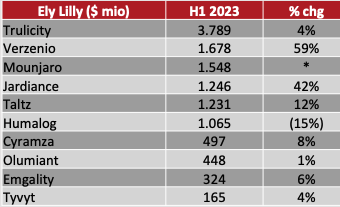
"Lilly's financial results in Q2 were led by Mounjaro sales and a strong performance from Growth Products," said David A. Ricks, Lilly's chair and CEO. "Exciting scientific breakthroughs, such as TRAILBLAZER-ALZ 2 in Alzheimer's disease and SURMOUNT-3 and -4 in obesity, encourage us to continue to make significant investments that support our new medicines including multiple launches expected by the end of 2023 to help more patients around the world."
Outlook: Raised
The company updated its 2023 financial guidance on both a reported and non-GAAP basis.
Revenue guidance increased by $2.2 billion to the range of $33.4 to $33.9 billion. Approximately $1.5 billion of this increase is driven by business development activity, including the sales of rights for the olanzapine portfolio, which closed in July 2023, and Baqsimi, with the remainder reflecting strong underlying business performance.
Product sales / Clinical / Regulatory
Clinical Development / Regulatory
- Positive Ph3 TRAILBLAZER-ALZ 2 results, showing donanemab significantly slows cognitive and functional decline in people with early symptomatic Alzheimer's disease
- Completed submission of tirzepatide in chronic weight management to the FDA and positive Phase 3 SURMOUNT-3 and -4 results
- Approval of mirikizumab in the European Union and re-submission in the U.S.
- Announcements of agreements to acquire DICE Therapeutics, Inc., Sigilon Therapeutics, Inc. and Versanis Bio, which would advance Lilly's research and expertise in treatments for autoimmune and cardiometabolic diseases;
Analyst’s view
Credit Suisse:
2023 Guidance upgrade following impressive 2Q23. Overall 2Q23 sales came in 10% ahead of expectations. Heading into 2Q23 there was a large degree of investor nervousness for Mounjaro's performance. Importantly its was >30% above consensus expectations, which helped drive the +16% share price move today (along with a positive read-across from Novo's SELECT study).
Barclays:
Lilly's 2Q print was a tale of two stories, but really only the Mounjaro beat mattered, easily beating consensus as U.S. sales grew (+71% q/q) with net realized price per TRx (as per IQVIA volume) by +$100 to $343 relative to 1Q. Similarly OUS sales grew 100% q/q to $64mn, with the company characterizing that as demand-driven (across UAE and Japan). Ex-Mounjaro, it was more a mixed bag. Trulicity missed meaningfully; Lilly highlighted pricing headwinds, but framed the 1H cadence as a more appropriate measure of trends vs. focusing on 2Q. Otherwise, the beat was primarily driven by the Baqsimi divestiture, and similarly it and the olanzapine divestiture justified ~$1.6bn of the increase in revenue guidance.
Gilead

Company’s view
“It was another strong quarter for Gilead, with continued commercial and clinical momentum,” said Daniel O'Day, Gilead's Chairman and Chief Executive Officer. “11% year-over-year growth across our base business was driven by our diverse portfolio of therapies for HIV, Oncology, and Liver Disease. We received positive regulatory updates for six of our therapies and presented a large body of data on our pipeline, reinforcing our growing potential to help more patients and communities worldwide.”
Outlook: Confirmed
For the full-year, Gilead expects:
- Total product sales between $26.3 billion and $26.7 billion, compared to $26.0 billion and $26.5 billion previously.
- Total product sales, excluding Veklury, between $24.6 billion and $25.0 billion, compared to $24.0 billion and $24.5 billion previously.
- Total Veklury sales of approximately $1.7 billion, compared to approximately $2.0 billion previously.
- Diluted earnings per share between $4.50 and $4.85, compared to $4.75 and $5.15 previously.
Product sales / Clinical / Regulatory

Clinical Development / Regulatory
- FDA and European Commission approval to extend the use of Veklury to treat COVID-19 in people with severe renal impairment, including those on dialysis.
- Received EC approval for Trodelvy as monotherapy for the treatment of adult patients with unresectable or metastatic HR+/HER2- mBC who have received endocrine-based therapy, and at least two additional systemic therapies in the advanced setting.
- Presented longer-term overall survival (“OS”) data from the Phase 3 TROPiCS-02 study evaluating Trodelvy in pre-treated HR+/HER2- mBC, demonstrating durable and clinically meaningful improvement in median OS versus comparator chemotherapy.
Analyst’s view
Morningstar:
We're maintaining our $97 fair value estimate for Gilead following a strong second quarter that displayed both the firm's continued ability to gain share in the HIV market with Biktarvy as well as potential to grow the relatively new oncology business into a key pillar of its wide moat. Gilead's strength in oncology and HIV drove 5% revenue growth in the second quarter (11% product sales growth excluding COVID-19 drug Veklury). Gilead slightly raised its product sales guidance to $26.3-$26.7 billion, despite lowering Veklury guidance to $1.7 billion, which implies a solid 6.5%-8% growth of the base business. Our own forecast is at the high end of this range, and we continue to see shares as undervalued, as the market fails to give Gilead credit for its long-term potential in HIV (lenacapavir in treatment and prevention) and oncology (further expansion of its portfolio into lung cancer and immuno-oncology).
BMO:
Topline beat points to commercial execution in HIV and expansion from the oncology franchise. With steady growth becoming our base case for Gilead's HIV business, investors look to expansion of the oncology business as the next key driver of growth; cell therapy and solid tumors drive upside. Gilead's manufacturing prowess has removed supply constraints, enabling broad uptake and expansion into earlier lines of treatment. Near-term, our focus is on Gilead's developing lung cancer franchise with updates for Trodelvy's Evoke-02 study in 1L mNSCLC coming at World Lung on September 10th.
Bayer

Company’s view
Bill Anderson took over from Werner Baumann as CEO on June 1.
Crop Science registered a significant decrease in sales that was mainly due to lower volumes and prices for our glyphosate-based products.
Sales at Pharmaceuticals were level with the prior-year period. The division recorded significant gains for Nubeqa™ and Kerendia™ as well as a strong performance in the Radiology business, but registered declines particularly for Adalat™ and Aspirin™ Cardio in China. Sales at Consumer Health rose, with substantial growth in the Dermatology and Pain & Cardio categories in particular.
Outlook: Lowered
Based on the current development of business and our internal planning, we have lowered our outlook for full-year 2023. This is mainly due to a further significant decline in sales of glyphosate-based products.
Product sales / Clinical / Regulatory

Clinical Development / Regulatory
- Asundexian // In May, the US Food and Drug Administration (FDA) granted Fast Track Designation for the investigational drug asundexian as a potential treatment to prevent stroke and systemic embolism in people with atrial fibrillation.
- Aflibercept // In May, initiation of Phase III QUASAR study, designed to evaluate the efficacy and safety of aflibercept 8 mg dosed at extended treatment intervals compared to the standard of care, Eylea™ (aflibercept 2 mg), in macular edema secondary to retinal vein occlusion (RVO).
- Runcaciguat // In April, discontinuation of development of runcaciguat, a soluble guanylate cyclase (sGC) activator in Phase II clinical development, in the indication chronic kidney disease (CKD).
Analyst’s view
Jeffreys:
We reduce Bayer EBITDA 6%, reduce our PT to €67, and maintain our BUY rating. The key positive from Q2 is clear communication from CEO Bill Anderson that all strategic options are on the table to ensure Bayer has the best structure to support its respective businesses achieving their respective missions, including removing corporate bureaucracy, the litigation overhang, and reducing debt. A strategic review/targets in early FY24 remain the key catalysts.
Stifel:
In our view, the main feedback from the Q2 conference call were the CEO's comments to analyze strategic options for the company's structure. The task is to decide on whether the current structure is the best one to accomplish the mission of all segments. In this regard, the head of Consumer Health outlined that it is an advantage being part of Bayer. The head of Pharma mentioned limitation in capital allocation, and that Crop Science is about speed to market. We see these comments as signs that a split of the company might be on the agenda. This could unlock value for shareholders, in our view. While we have a price target of €68 as the average of several valuation methods, we highlight that the SOTP based on peer multiples derives a higher value of €81.
Amgen

Company’s view
"We had a very strong quarter, serving more patients across all geographies and therapeutic categories and delivering record revenues and non-GAAP earnings per share," said Robert A. Bradway, chairman and chief executive officer. "Positive data being shared today illustrates the rapid progress we are making in advancing our pipeline of potential first-in-class medicines."
Outlook: Confirmed
2023 Guidance (Excludes any contribution from the announced acquisition of Horizon Therapeutics plc).
The Company expects the announced acquisition of Horizon Therapeutics plc (Horizon) to close by mid-December 2023.
For the full year 2023, excluding any contribution from the announced acquisition of Horizon, the Company now expects:
- Total revenues in the range of $26.6 billion to $27.4 billion.
- On a GAAP basis, EPS in the range of $14.30 to $15.41, and a tax rate in the range of 17.0% to 18.5%.
- On a non-GAAP basis, EPS in the range of $17.80 to $18.80, and a tax rate in the range of 17.5% to 18.5%.
Product sales / Clinical / Regulatory

Clinical Development / Regulatory
- Amgen reported that its DLL3-targeting, bispecific T-cell engager (BiTE) tarlatamab showed a "durable" objective response rate, the primary endpoint of the Phase II DeLLphi-301 study in patients with relapsed or refractory small-cell lung cancer (SCLC) who have failed two or more lines of treatment. The benefit "substantially" exceeded what was previously reported in a Phase I study
- The drugmaker also said it obtained positive results in the Phase III CodeBreaK 300 study evaluating Lumakras with Vectibix, versus current standard care in chemo-refractory metastatic KRAS G12C-mutated colorectal cancer. The trial met its primary endpoint of progression-free survival (PFS) for both the 240mg and 960mg doses, with no new safety signals.
Analyst’s view
Mizuho:
Numbers look ok: product sales overall beat, but Lumakras weak. Slight bump on revenue guidance, but still bracketing consensus. Key comment ... "Will discontinue further enrollment in the study of LUMAKRAS in combination with a PD-1 inhibitor in KRAS G12C mutated NSCLC."
BMO:
In our view, the key commercial takeaways from the print were 1) underlying strength across legacy business (Enbrel $1.07B vs. $880M cons, Neulasta $236M vs. $201M, Repatha $424M vs. $388M), 2) partially offset by recent launches that continue to lag expectations (Lumakras $77M vs. $84M cons, Aimovig $82M vs. $86M cons). Base business is often a melting iceberg, and today's reversal of that narrative will likely receive a warm reception by investors — if validated in 2H23. In our view, keeping guidance essentially flat (top-line to $27.0B at midpoint vs. $26.75B prev; EPS raised +1%) is conservative but what investors expect from Amgen and could set up for a beat later in the year.
Novo Nordisk

Company’s view
Lars Fruergaard Jørgensen, president and CEO: "We are very pleased with the sales growth in the first half of 2023. The growth is driven by increasing demand for our GLP-1-based diabetes and obesity treatments, and we are serving more patients than ever before. The performance in the first six months has enabled us to raise the outlook for the full year.
Within R&D, we are very excited about the results from the SELECT trial. Obesity is a serious chronic disease associated with many comorbidities and the results from SELECT demonstrate that comorbidities associated with the condition can be significantly reduced by treating people with semaglutide"
Outlook: Raised
For the 2023 outlook, sales and operating profit growth at CER are now expected to be 27-33% and 31-37%, respectively. Sales and operating profit growth reported in Danish kroner are expected to be 6 and 9 percentage points lower than at CER, respectively.
Product sales / Clinical / Regulatory

Clinical Development / Regulatory
- Submission of dasiglucagon for treatment of severe hypoglycaemia to the European Medicines Agency (EMA).
- Phase 1 trial with a fixed dose combination of semaglutide and an SGLT2 inhibitor completed.
- Successful completion of the SELECT cardiovascular outcomes trial with semaglutide 2.4 mg.
- Successful completion of the OASIS 1 phase 3 trial with oral semaglutide 50 mg in people with obesity or overweight.
- Successful completion of phase 3 trial with semaglutide 2.4 mg in people with heart failure with preserved ejection fraction (HFpEF).
- Phase 2 trial completed with PYY 1875 in people with obesity.
- Sogroya® approved in Japan and the EU for the treatment of children with growth hormone deficiency.
- Phase 3 programme initiated with ziltivekimab in people with heart failure with preserved injection fraction.
Analyst’s view
Morgan Stanley:
We expect Novo Nordisk's share price to underperform this morning following strong recent performance, with a 2% miss on 2Q23 revenue estimates and consensus expectations already at the top end of the positively revised FY23 guidance. We expect ongoing questions surrounding supply chain dynamics and net pricing behind the GLP-1 franchise, where volume growth dynamics remain strong. We expect the positive Wegovy SELECT trial and heart failure pivotal data to be presented at the AHA 2023 meeting to remain in focus (representing the tip of the iceberg of a broad co-morbidity opportunity), whilst investors await: (1) a clinical trial update on amycretin and (2) commentary on Novo's broader ambitions in the oral diabesity space following the acquisition of Inversago Pharma.
Third Bridge:
Analyst Lee Brown suggested Wegovy's growth could help soften the blow of light sales from diabetes drugs Victoza, Tresiba, Levemir and Fiasp. "Despite the impressive performances by both Ozempic and Wegovy, we suspect analysts will need to sharpen their pencils and evaluate projections for much of the rest of Novo's drug portfolio," Brown said.
Moderna

Company’s view
“Second quarter sales were on target, given the seasonal nature of Covid. I am pleased with the progress our U.S. commercial team has made to get new contracts in place for fall 2023. We are on track to deliver 2023 sales between $6 billion to $8 billion, depending on Covid vaccination rates in the U.S.,” said Stéphane Bancel, Chief Executive Officer of Moderna. “Our late-stage clinical pipeline is firing on all cylinders with four infectious disease vaccines in Phase 3, including RSV which was recently submitted to regulators for approval. Our individualized neoantigen therapy is now in Phase 3 for melanoma and our lead rare disease program for PA is in dose confirmation. We believe that all these products should launch in 2024, 2025 or 2026, and we are continuing to invest in scaling Moderna to bring forward an unprecedented number of innovative mRNA medicines for patients.”.
Outlook: Raised
Company expecting 2023 COVID-19 vaccine sales of $6 billion to $8 billion, dependent on U.S. vaccination rates
Clinical Development / Regulatory
- Company submitted its investigational RSV vaccine to several regulators globally ahead of potential 2024 launch
- With its partner Merck, the Company began Phase 3 trial of mRNA-4157, its individualized neoantigen therapy (INT), in combination with Keytruda®, for high-risk melanoma
- Enrollment has been completed in the Ph3 immunogenicity trial (P303) for an enhanced formulation of mRNA-1010. This updated formulation is anticipated to generate an improved immune response to influenza B strains and is intended to enable licensure of mRNA-1010 through accelerated approval. MRNA expects to share an update on P303 in 3Q23.
Analyst’s view
Morgan Stanley:
Moderna posted a 2Q beat and raised 2023 COVID vaccine sales guidance. We expect a relatively limited stock reaction.
Risks to Upside
- Supporting clinical data across several modalities
- Meeting timelines and continuing to expand a diversified pipeline
- Launch vaccines in multiple indications including flu, RSV, CMV, etc.
Risks to Downside
- Efficacy and/or safety concerns cause investors to write-off subsequent readouts across additional modalities
- Delays in Moderna's ability to generate significant clinical data
- Stronger than expected competitor data
Jeffries:
Q2 mostly expected, incl seasonally low vaccine shipments. Guidance is the mixed bag investors will poke at as prior APA (contract) revenue of $5B is now moved to $4B due to deferrals by some countries (no big surprise due to ongoing dynamics of Covid), while MRNA also guides to "new" US commercial and EU, Japan revs of $2-4B. The total guidance of $6-8B is in line w/ consensus $7B, so net-net still in zone of consensus models.
Merck

Company’s view
“For us, 2023 remains a transition year,” said Belén Garijo, Chair of the Executive Board and CEO of Merck. “In the second quarter, our Healthcare business once again proved to be a growth driver. We are building on the strengths of our diversified business model. We remain confident of our mid-term growth ambition and in delivering € 25 billion in sales by 2025.”
Outlook: Lowered
Updated forecast for fiscal 2023
Merck is updating its forecast for fiscal 2023. The reasons for this are, in particular, the persistently high inventory levels of our Life Science customers, the further delayed recovery of the market for semiconductor materials, an increased cost level due to inflation and an even stronger negative foreign exchange impact. The company once again confirms its mid-term objective of delivering sales of €25 billion by 2025. For fiscal 2023, the forecast for the Group is as follows:
- Organic sales development: −2% to +2%, totaling €20.5 billion to €21.9 billion
- Organic sales growth excluding Covid-19 business: +1% to +5%
Product sales / Clinical / Regulatory

Clinical Development / Regulatory
- Oncology franchise strenghtened by regaining exclusive worldwide rights to develop, manufacture and commercialize Bavencio® (avelumab), effective June 30, 2023.
- At this year's ASCO GU, we announced the findings of a new analysis of long-term follow-up data from the Phase III JAVELIN Bladder 100 trial.
- At the Americas Committee for Treatment and Research in Multiple Sclerosis (ACTRIMS) Forum 2023, we presented new four-year efficacy and safety data for the investigational Bruton's tyrosine kinase (BTK) inhibitor, evobrutinib, in RMS.
Analyst’s view
Credit Suisse:
Merck KGaA reported headline 2Q23 results with sales 1% and Core EBITDA 4% ahead of consensus expectations. However the headline results was distorted by a number of one-time benefits including gains from disposals in Pharma (known, CSe EUR40m, but not quantified), Rebif channel stocking and the sales of a portfolio of OLED emitter patents in Electronics (not known, unquantified).
As expected, the company has cut FY23 guidance to reflect underlying weakness in Life Science and slower recovery in demand in Electronics. New FY23 guidance brackets CS estimates for FY23. However, the impact of the unquantified 2Q one-time gains, presumably included in guidance, means our FY23 assumptions are not yet fully comparable.
Jeffries:
Risks include (1) growing competition in Life Sciences from cheaper online sources; (2) Evobrutinib failing to show statistical significance in phase III; (3) Semiconductor Solutions is hit harder than expected as the semi-cycle turns and growth stalls.
Related Insights & Outlooks


.avif)